
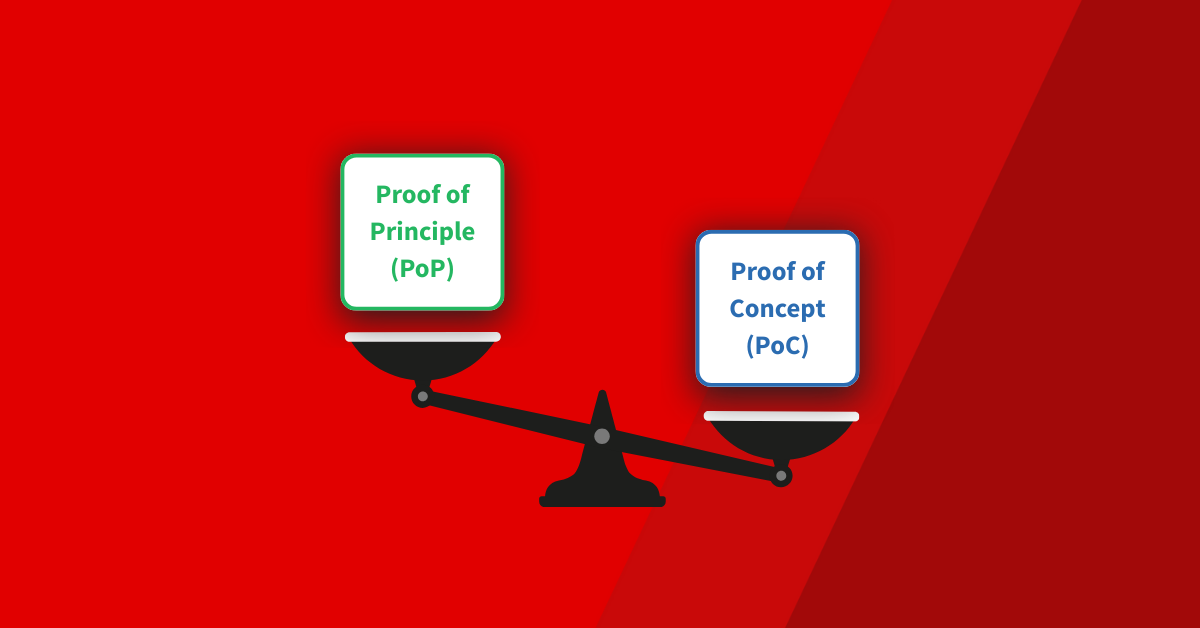
The terms proof of principle (PoP) and proof of concept (PoC) are sometimes used interchangeably in quality analysis (QA) and test automation, but they have distinct meanings and purposes.
While both aim to demonstrate the feasibility or functionality of a product’s features at certain points within the SDLC, their approaches and scopes differ significantly.
Understanding these differences is vital for effective project management and product design, and knowing when to implement each can help you streamline your workflows and release a product with fewer bugs from the start.
In this article, we’ll examine the difference between proof of principle and proof of concept as it pertains to QA and test automation. We’ll look at each term’s definition, significance, and application at different points in the design process and show how test automation tools like Ranorex can elevate both throughout the SDLC.
What is a proof of principle and why is it important?
Rather than focus on the implementation of a feature within a software product, PoP evaluates that feature’s potential and whether it could work successfully. Serving as an early-stage feasibility check, a PoP typically involves creating a small-scale model or prototype to test a feature’s specific functionality, answering the question, “Can this be done?”
The goal of a proof of principle in software testing
The goal of a proof of principle in software testing is to validate the underlying principles or theories behind a product or feature without necessarily proving its viability or scalability.
Why proof of principle matters in the SDLC
PoPs are one of the first steps in the SDLC, providing a foundation upon which a proof-of-concept template or further development can be built.
How a PoP supports better testing and decision-making
For example, a PoP lets testers explore a new automation approach to technology, validate or disprove any assumptions regarding the suitability of a given testing method or process, identify potential challenges or barriers to implementation, and reveal any permanent hurdles that would prevent teams from investing in building any further.
Benefits of early feasibility validation
This early validation helps reduce logistical issues associated with time, cost, and resources in the later stages of the project, and it also aids in decision-making by providing stakeholders with tangible evidence of the concept’s viability. It also keeps all goals aligned between developers, testers, and other stakeholders, so that the final product meets or exceeds expectations.
What is a proof of concept?
Proof of principle occurs earlier than proof of concept in software testing. By answering the question, “Does this work?” instead of “Can it be done?”, a PoC demonstrates the practicality and potential value of implementing a software feature in a real-world scenario, since the viability has already been validated at the PoP level.
In test automation evaluation and QA, proof of concept often involves building a prototype or a pilot project to mimic the finished product. For example, teams could build a small but realistic automated workflow as part of their robotic process automation (RPA) technology and use it to assess its value for their operations.
They could use the workflow to test the product’s stability, reliability, usability, and performance, as well as to validate its ROI if deployed into their product’s environment. Some components of the PoC process in test automation include:
- Defining the scope and purpose of the remaining PoC journey
- Selecting the tools, frameworks, and testing environment
- Executing some limited automation
- Analyzing the findings of your automation
- Reporting results to stakeholders
PoCs require more comprehensive testing and validation to showcase the software’s performance and functionality, but they’re critical for bridging the gap between concept and full-scale development. They let teams evaluate the difficulty of maintaining a proposed feature or update and analyze how well it would scale with the rest of their operations.
PoCs also provide tangible results for stakeholders by demonstrating a feature’s effectiveness. It also enables teams to pivot their automation strategy if they identify any issues along the way.
How PoC supports test automation and RPA projects
The PoC process helps identify potential challenges and risks earlier in the testing and development lifecycle. It can reveal potential compatibility issues, scalability concerns, or integration complexities and lets teams streamline their test automation and RPA projects. Some benefits that the PoC stage can bring to your test automation and RPA efforts are:
- Quicker comparisons. Teams can evaluate multiple automation tools and methods during the PoC process, such as record/playback, hybrid, or low-code approaches. This lets them see which one best aligns with their broader software environment, enabling a smoother implementation.
- Broader testing coverage. During the PoC stage, teams evaluate their testing applications across multiple interfaces, such as desktop, web, or mobile devices. This enables broader testing coverage earlier on, even though the scope is limited to feasibility at this stage.
- Smoother integration. By proving that a new functionality interacts as expected with your existing pipelines, you can ensure a smoother integration at the outset of a build and incur less technical debt.
The PoC also demonstrates the stability of your automation environment as it interacts with the rest of your build. The result is fewer unexpected bugs at deployment, and a finished product that performs as expected.
Key differences between PoP and PoC
The following table demonstrates the key differences and similarities between PoP vs PoC
| Proof of Principle (PoP) | Proof of Concept (PoC) | |
| Goal | To demonstrate viability (“Can we do it?”) | To demonstrate functionality (“Does it work?”/”Should we do it?”) |
| Scope | Narrower scope, focusing on a specific feature’s potential | Broader scope, focusing on a feature’s usefulness and performance |
| Depth | Less depth, focusing only on feasibility | Greater depth, focusing on benefits, integration, scalability, ROI, and functionality |
| Expected artifacts | Reports, documentation, case studies | Sample tests, test execution reports, defect reports, test logs |
| Stakeholders | Board members, executives, managers, developers | Board members, executives, managers, developers |
| Timeline | Pre-development | Early stages of development |
| Measurement of success | Proven viability | Proven value and usability |
Another key difference between PoP and PoC is when they should be used within the SDLC. Teams should employ PoP for early initial testing workflows such as validating automation against dynamic UI elements, while PoC could be useful when demonstrating that automation reduces manual regression work during testing.
How Ranorex supports both PoP and PoC validation
Having the right test automation tool helps you streamline your testing workflows and validate the results of your PoP and PoC processes sooner. Ranorex offers a range of test automation functionalities, supporting both PoP and PoC test automation:
- Easy setup for PoP feasibility testing
- Reliable object recognition for complex applications
- Support for desktop, web, and mobile
- Low-code + full-code flexibility for PoC development
- Integration with CI/CD for real-world scenario testing
Automation tools like Ranorex let you evaluate the potential of new functionality so you can decide if you want to move forward with implementation. The result is faster validation of your ROI so that you can see what works and what doesn’t. Contact us to see how it works.
Bottom line
Both PoP and PoC strategically reduce the risk of implementing automation into your pipeline. They enable smarter tool selection and improve automation outcomes in the long run, but they do it in different ways.
PoP prioritizes feasibility and employs a deeper, narrower exploration of your automation pipeline at the start of the design process, while PoC evaluates if a feature would deliver adequate value. Ranorex’s end-to-end test automation solution supports both PoP and PoC processes. Start a free trial today.


